
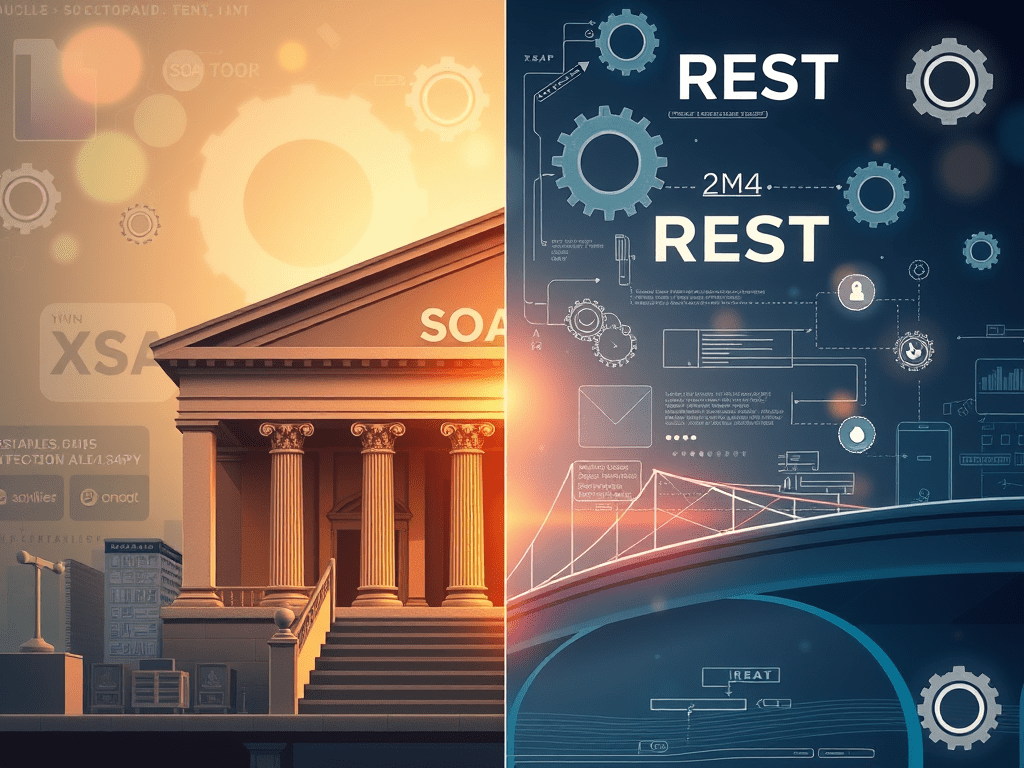
“If REST is sleek and modern, why are banks still running on SOAP? Isn’t it slow, heavy, and outdated?”
Enterprise Service-Oriented Architecture (SOA) takes the basics of SOA and elevates them with business semantics, built largely on the heavyweight SOAP (Simple Object Access Protocol).
Why SOAP Feels Heavy?
- XML Wrapping: SOAP requests and responses are wrapped in XML. This makes them verbose and bulky, and parsing XML is far more intensive than working with JSON.
- WS- Standards*: SOAP must adhere to a long list of WS-* standards, adding headers and processing overhead.
- WSDL Definitions: Services are described in WSDL (Web Services Description Language). It’s precise, but also rigid and harder to evolve than REST’s lightweight approach.
- Extra Features: Security tokens, digital signatures, and encryption make SOAP robust, but they also increase payload size and slow transmission.
At first glance, SOAP seems outdated. REST feels leaner, faster, and built for the modern digital world.
So why is SOAP still alive in banking?
In banking, robustness always beats trendiness.
- Security & Reliability: Banking systems demand strict security, guaranteed delivery, and transaction integrity. SOAP’s WS-* standards provide these out-of-the-box. With REST, the same guarantees require custom implementation.
- Industry Standardization: For decades, SOAP has been the de facto standard for integrating with payment networks, SEPA, SWIFT, and even government systems. Replacing all that with REST isn’t practical.
- Reliable Messaging: SOAP’s WS-ReliableMessaging supports delivery, ordering, and duplicate suppression — all critical for financial transactions. REST can do this too, but only if carefully designed at the application level.
REST Isn’t a Taboo
This doesn’t mean REST has no place in banking. Quite the opposite. REST is widely adopted in:
- Fiori apps
- API-led integrations
- Event-driven architectures
But SOAP remains the workhorse for the hardcore backend — payments, settlements, compliance — where stability, standardization, and trust are non-negotiable.
REST brings agility to the edges. SOAP holds down the fort at the core. Together, they balance innovation with reliability, which is exactly what the banking industry needs.
💬 I’d love to hear your thoughts — have you seen SOAP still dominating in your bank, or is REST starting to take over in your banking integrations?

 Harshit Agrawal
Leave a comment